Over the last couple of weeks, as part of our ERP Software Solution Comparison Series, we’ve taken a look at how NetSuite and Sage compare to Acumatica. After almost a decade of experience in the business of customizing, implementing and delivering business-changing software — at Aqurus, we know that not all ERP systems are created equal. All ERP systems have to perform the same basic accounting and business management functions to run your business. However, if you compare them on some key criteria, you’ll realize they’re very different.
Continuing in this series, this week, we are going to stack Acumatica up against Microsoft Dynamics GP. Both are highly customizable and flexible ERPs, but which one comes out on top? We hope this article helps you find the best ERP for your business.
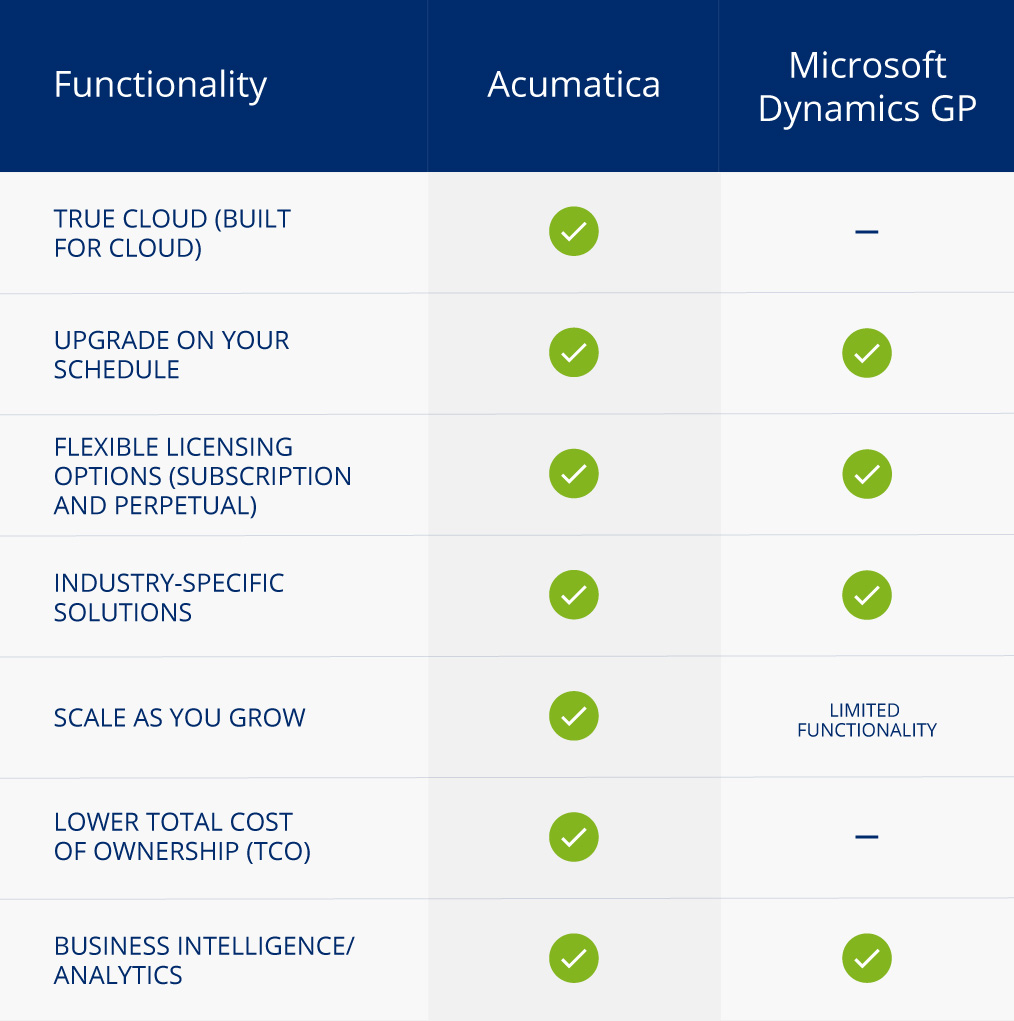
With technology advancing rapidly, mid-market ERP solutions have transformed significantly to try and keep up. Many of these systems were built on legacy software features that have not been upgraded, instead of being constructed as a Software-as-a-Service (SaaS) solution from the start. This distinction is critical when comparing newer software solutions against outdated systems like Microsoft Dynamics GP that are marketed as cloud ERP.
Microsoft Dynamics GP is a mid-market ERP product that integrates financial management, manufacturing, distribution and CRM functionalities.
One of the benefits of Microsoft Dynamics GP is that it’s built on the strength of Microsoft’s popular productivity tools. These include MS Office applications, SQL databases and MS SharePoint to help SMBs and large enterprises manage their finances efficiently. A drawback is the software was built using a much older system architecture. This can be an issue when using it alongside newer technologies like cloud deployment options and customizations using current development tools.
Formerly Great Plains, it was renamed Dynamics GP when Microsoft began to shift its focus to the cloud. Microsoft incorporated a web-based interface to the software to relabel it as a cloud system. On the other hand, Acumatica was built from the ground up as a SaaS solution with additional options for private and on-premise hosting to provide users with true flexibility.
SealTech wasn’t happy using Microsoft Dynamics GP because functionality and integration were lacking. Guardian SealTech chose to implement Acumatica because of its robust Cloud ERP offering, which includes more functionality, better prices and more value to users.
>> Success Story
Since 2008, C&O had used Microsoft Dynamics GP for accounting and payroll, along with special inventory software. After a few years, management grew frustrated with their outdated set-up. They decided to switch to Acumatica because it was browser-based and more customizable than Microsoft Dynamics GP.
>> Success Story
Acumatica Cloud ERP and Microsoft Dynamics GP are both viable options for SMBs looking to leverage increased connectivity and strong partner and user communities. However, GP relies on outdated technology covered up by new features, while Acumatica a true modern Saas Erp that delivers scalability and seamless cloud functionality.
Need more information on the software? Check out the overview of Acumatica Cloud ERP Software.
Remember, the company you choose to implement your software dictates the success or failure of your software investment. At Aqurus, we’re passionate about providing superior ERP solutions and support.