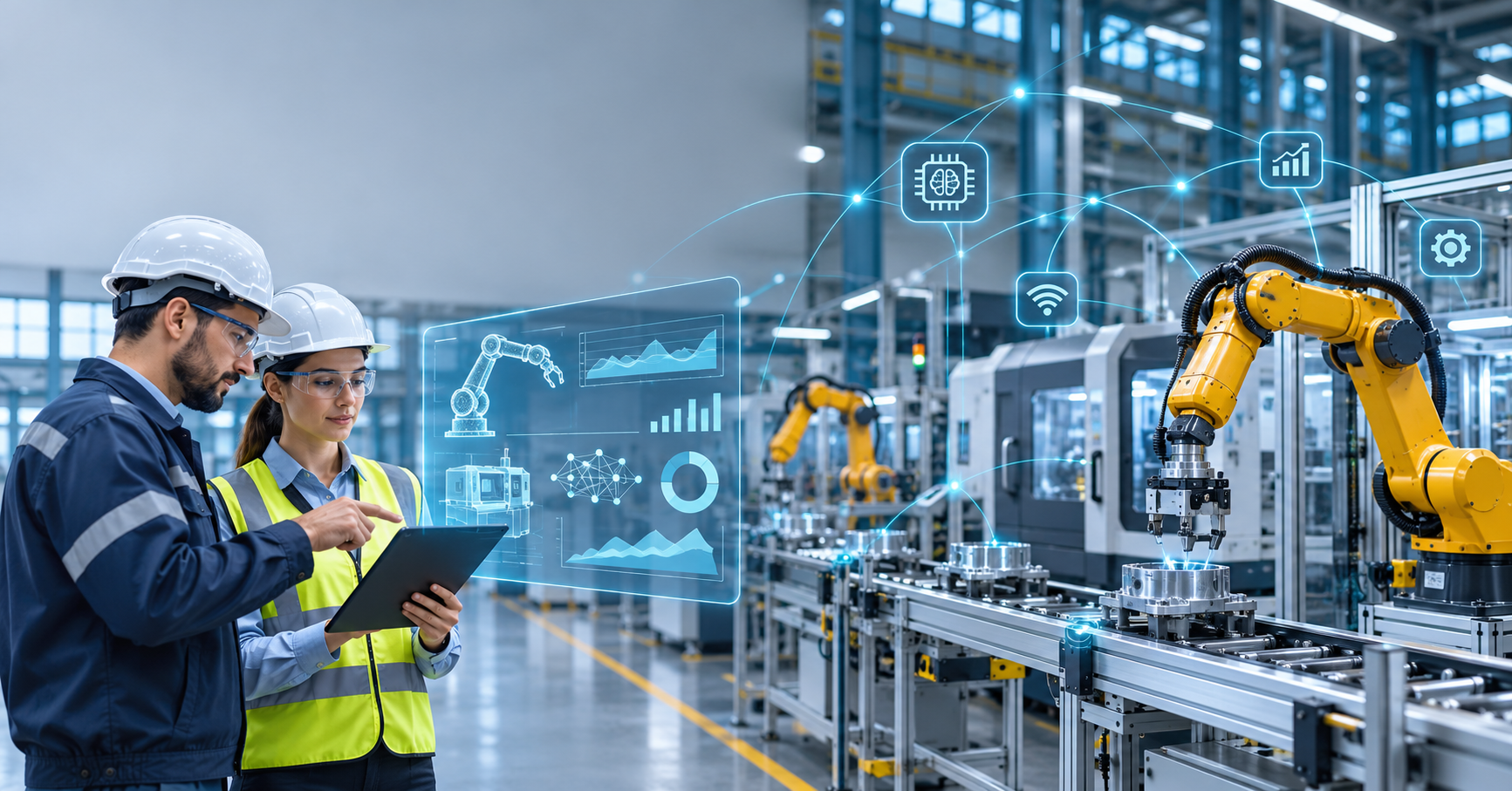
Artificial intelligence is moving beyond experimentation in manufacturing. Plant managers want to know which orders are at risk of running late. Purchasing teams need earlier warnings about material shortages. Finance leaders want to identify production cost overruns before they affect margins.
For Canadian manufacturers, the opportunity is not simply to introduce more technology. It is to make better use of the operational information they already collect.
Acumatica Cloud ERP provides a connected foundation for this approach, bringing together production, inventory, purchasing, scheduling, and financial information. Its newer AI capabilities make that information easier to access and use, while its integration architecture creates opportunities to connect specialized AI applications.
What Is AI in Manufacturing?
AI in manufacturing uses artificial intelligence to analyze operational data, identify patterns, answer questions, and support decisions across production, inventory, quality, and maintenance. When combined with a connected manufacturing ERP such as Acumatica, AI can help employees identify risks sooner, reduce repetitive administrative work, and make better-informed decisions.
The important distinction is that AI does not replace manufacturing expertise. It gives experienced employees better information to work with.
Why AI in Manufacturing Starts With Connected ERP Data
Consider a manufacturer running several production lines with hundreds of components, changing customer priorities, and limited machine capacity.
The production supervisor manages scheduling in one system. Purchasing maintains spreadsheets. Inventory quantities are updated after shifts end. Finance receives actual manufacturing costs days later.
Even a sophisticated AI application will struggle to produce reliable recommendations when its information is incomplete or inconsistent.
This is where Acumatica Manufacturing ERP becomes valuable.
Acumatica connects manufacturing operations with inventory, purchasing, customer orders, and accounting. Bills of materials, routing information, work orders, material transactions, and production costs can be managed within the same business platform.
That shared information gives manufacturing teams a more reliable starting point for analytics and AI. Before an AI system can recommend what to do next, it needs an accurate picture of what is happening now.
Acumatica's Built-In AI Capabilities
Acumatica has expanded its AI functionality through its 2026 releases. The Acumatica 2026 R2 release, available in October 2026, includes AI Assistant, AI Automation, and AI Anomaly Detection capabilities designed to help users retrieve information, automate work, and identify exceptions.
These capabilities serve different purposes.
AI Assistant: Ask Questions About Manufacturing Operations
Instead of navigating multiple reports, authorized users can ask plain-language questions about information exposed to Acumatica's AI Assistant.
Examples of questions worth exploring include:
- Which production orders are currently at high risk of being late?
- What materials need to be staged at each work centre today?
- Which production orders are ready to start?
- Which completed orders exceeded planned labour costs?
- How has production schedule performance changed?
Acumatica provides manufacturing Generic Inquiries covering production orders, material readiness, scheduling, costs, and historical performance. The AI Assistant works with configured, exposed data sources. It is not unrestricted access to every record or an automatic replacement for operational reporting.
AI Automation: Reduce Repetitive Work
Acumatica's AI Automation capabilities extend its workflow and business-event functionality. Organizations can explore automating repetitive administrative tasks, routing information for review, and initiating configured workflows based on business conditions.
For a manufacturer, the opportunity may involve reducing time spent gathering order information, reviewing exceptions, or coordinating work between departments.
AI Anomaly Detection: Focus Attention on Exceptions
Acumatica also identifies anomaly detection as part of its embedded AI capabilities. The objective is to help users recognize unusual patterns or transactions rather than manually inspect every record.
The scope of an individual application depends on the configured features and available data. Specialized machine-sensor anomaly detection, for example, may require additional software and integration.
Smarter Production Planning Begins With Accurate Shop-Floor Information
AI becomes considerably more useful when manufacturers capture what actually happens during production.
Acumatica Manufacturing Edition includes Material Requirements Planning (MRP), Advanced Planning and Scheduling (APS), production management, and shop-floor data collection.
The enhanced Shop Floor Kiosk in Acumatica 2026 R2 supports recording labour, production quantities, material issues, substitutions, and additional production information. That information improves the accuracy of inventory balances, work-in-process costs, and production records.
APS uses manufacturing constraints and capacity information to develop more realistic production schedules. Enhancements in 2026 R2 include more precise scheduling and improved handling of work-centre constraints and overlapping shifts.
APS itself should not be confused with generative AI. It is a planning and scheduling capability. The value comes from combining accurate operational planning with AI-assisted analysis.
A production manager can use APS to evaluate capacity, while AI Assistant helps surface information about schedule risk, material readiness, or historical performance. Explore the underlying functionality in Acumatica Manufacturing Edition.
Six Practical Ways AI Can Help Manufacturers Using Acumatica
1. Identify Production Delays Before They Become Customer Problems
A production order may appear to be progressing normally until a critical work centre becomes overloaded or materials arrive late.
Acumatica provides production schedule information, material readiness inquiries, and production order risk indicators that can be accessed through its configured AI Assistant. A production manager can investigate which orders are at risk and determine where intervention is needed.
Rather than reviewing every open order, the team can concentrate on exceptions that threaten customer commitments.
2. Improve Material Planning and Inventory Decisions
Inventory management involves balancing competing costs. Holding excessive material ties up working capital. Carrying too little can interrupt production and force expensive emergency purchases.
Acumatica's MRP and inventory management capabilities provide the operational planning foundation. AI-assisted inquiries can help identify material shortages, outstanding requirements, and production orders affected by unavailable components.
More advanced forecasting applications can also be connected to Acumatica to analyze demand patterns, seasonality, and supplier performance. MRP and inventory planning are established ERP capabilities, while specialized AI forecasting may require additional configuration or an external application.
3. Detect Manufacturing Cost Overruns Earlier
Manufacturing profitability depends on accurate material, labour, machine, and overhead costs. A production manager may not immediately realize that a particular component consistently requires more labour than estimated.
Acumatica captures planned and actual production costs, providing visibility into variances. With AI-assisted access to production performance and variance data, teams can investigate questions such as, "Which completed production orders had the largest material cost variance last month?"
This helps connect operational performance to financial results. It creates opportunities to review BOM assumptions, adjust standard times, and improve estimating accuracy.
4. Strengthen Quality Management and Traceability
Quality issues often involve information spread across inspection records, production orders, lot numbers, and supplier data. Acumatica provides manufacturing records and traceability capabilities that help maintain operational context.
Where additional quality-management or inspection systems are involved, AI applications can be integrated to analyze recurring defects, inspection trends, and historical non-conformances.
Computer-vision systems can use cameras and specialized AI models to identify potential defects on a production line. These applications should be understood as integration opportunities, not standard out-of-the-box Acumatica computer-vision features.
The broader benefit is connecting inspection findings with production, inventory, and financial records so employees can investigate causes and evaluate the cost of quality problems.
5. Connect Machine Data for Predictive Maintenance
Unplanned equipment downtime can disrupt schedules and increase manufacturing costs. Many modern machines provide information about operating hours, vibration, temperature, and other conditions.
Through Industrial Internet of Things (IIoT) platforms and specialized analytics, manufacturers can use this information to identify patterns associated with equipment deterioration.
Acumatica can form part of the business-system integration, connecting operational alerts with production planning, purchasing, and relevant maintenance processes.
For example, an external monitoring system might flag unusual machine vibration. The resulting information can support maintenance coordination and help teams evaluate the effect on scheduled orders. This requires suitable sensors, monitoring software, and integration design.
Read more about IIoT integration and manufacturing ERP.
6. Give Managers Faster Answers Across Departments
One of the most accessible applications of AI is reducing the effort required to find and interpret existing information.
A general manager may want to understand which customer commitments are threatened by production delays. An operations director may need to identify recurring bottlenecks. A controller may want to investigate deteriorating production margins.
When the necessary data is available through properly configured Acumatica inquiries, AI-assisted tools can help users answer questions without requiring a new custom report for every request. This can be particularly useful for smaller manufacturing teams where employees manage several responsibilities.
Connecting Acumatica With ChatGPT and Other AI Tools
Manufacturers are not limited to the AI features embedded directly in their ERP.
Acumatica's 2026 R2 release introduced support for connecting MCP-compatible AI tools with governed Acumatica data. The Model Context Protocol (MCP) provides a standard way for compatible AI applications to interact with connected business systems.
This offers a path for building business-specific AI workflows without relying on manual spreadsheet exports for every question.
For example, a manufacturer could explore an authorized AI assistant that retrieves production performance information and helps prepare a daily management summary.
More specialized applications may use Acumatica's APIs or integration services to connect forecasting models, production equipment, document-processing tools, and other business platforms.
External AI services still require evaluation of security, permitted data access, service-provider terms, and information handling. The objective is controlled integration, not unrestricted AI access to company information.
For a technical perspective, read System Integrations for AI Adoption in Manufacturing: A CTO's Roadmap.
What Can Manufacturers Use Today, and What Requires Integration?
Manufacturers should distinguish currently available ERP functionality from advanced applications that require additional software or implementation work.
| Manufacturing capability |
Implementation approach |
| Production order questions and material readiness analysis |
Acumatica AI Assistant with enabled and configured manufacturing inquiries |
| Production planning, MRP, and capacity scheduling |
Acumatica Manufacturing Edition and relevant planning modules |
| AI-assisted workflow automation and anomaly analysis |
Acumatica AI capabilities, subject to configuration and availability |
| External AI access to authorized ERP information |
Acumatica MCP connection or other supported integrations |
| Predictive machine maintenance and computer-vision inspection |
Additional industrial systems, AI models, and integration |
The advantage of this approach is flexibility. A manufacturer can start with established Acumatica functionality and expand into specialized AI applications when a clear business case exists.
A Practical 90-Day Roadmap for Manufacturing AI Adoption
Days 1–30: Establish the Baseline
Identify a persistent issue such as material shortages, production delays, or costly manual reporting. Review the accuracy of the supporting information in Acumatica, including production transactions, BOMs, inventory balances, and relevant master data.
Choose a measurable starting point, such as time spent preparing a weekly production report or the number of orders delayed by unavailable materials.
Days 31–60: Test a Focused Use Case
Configure the relevant ERP inquiries, permissions, and AI functionality. Select a small group of employees who understand the operational process.
Compare AI-assisted results with established reports and actual production records. Correct data issues and adjust the workflow before expanding.
Days 61–90: Measure and Expand Selectively
Evaluate whether the pilot improved the original business process. Look at accuracy, employee time saved, exception response time, and operational outcomes.
If the results justify further investment, consider the next application or external integration. For a broader architecture, explore Composable ERP and AI in Manufacturing Resource Planning.
Measuring the Return on AI in Manufacturing
Manufacturers should avoid evaluating AI projects solely by the number of features implemented. A useful business case connects the technology to operating results.
Depending on the application, appropriate performance indicators may include on-time production completion, material shortages, schedule adherence, expedited purchasing costs, inventory turnover, scrap, rework, or labour hours devoted to administrative tasks.
A reporting assistant should be evaluated on how much time it saves and whether employees can trust its answers. A predictive maintenance project should be evaluated against actual equipment downtime and maintenance costs.
The best initial use case is often a modest one with reliable data, clear ownership, and measurable value.
Keeping Manufacturing AI Secure and Reliable
Manufacturing records can contain sensitive customer information, pricing, supplier agreements, engineering details, and intellectual property. Organizations should evaluate AI integrations with the same care they apply to other business systems.
That includes restricting access according to employee responsibilities, validating data accuracy, reviewing third-party service terms, and ensuring meaningful human oversight.
AI-generated recommendations should not automatically change critical production schedules, release purchases, or alter controlled engineering records without appropriate authorization.
Manufacturers should also establish procedures for reviewing incorrect or incomplete AI responses. The goal is to improve decision-making while preserving accountability.
Frequently Asked Questions About AI and Acumatica Manufacturing ERP
Does Acumatica have built-in artificial intelligence?
Yes. Acumatica introduced AI capabilities in its 2026 releases, including AI Assistant, AI Automation, and AI Anomaly Detection. Available functionality depends on the product version, enabled features, configuration, and applicable entitlements.
Can Acumatica AI help identify production delays?
Yes. Acumatica's manufacturing AI Assistant can work with configured production schedule, material readiness, and production risk inquiries. This allows authorized users to investigate late orders, material constraints, and potential schedule problems.
Does Acumatica provide AI-powered predictive maintenance?
Acumatica does not provide a complete industrial predictive maintenance solution as a standard built-in manufacturing AI feature. Specialized monitoring, IIoT, and analytics platforms can be integrated with ERP information to support predictive maintenance processes.
Can ChatGPT and Claude connect to Acumatica ERP?
Acumatica 2026 R2 supports an MCP-based approach for compatible AI tools, including ChatGPT and Claude, subject to the ERP environment and connected service. Actual availability and security depend on connector configuration, user permissions, and the external AI service.
Is AI useful for small and midsize Canadian manufacturers?
Yes, particularly when a manufacturer already has reliable production and inventory data. Smaller organizations may benefit from AI-assisted reporting, material availability analysis, and administrative automation before considering complex machine-learning projects.
What is the difference between ERP automation and AI in manufacturing?
Traditional ERP automation follows defined rules and business processes. AI can interpret natural-language questions, identify patterns, and provide data-driven insights. Combining reliable rules-based ERP processes with selective AI capabilities can be a practical approach.
How should manufacturers begin an AI project?
Start with one operational problem, confirm that the required information is accurate, and choose a measurable pilot. Use existing ERP capabilities wherever practical before investing in specialized AI systems.
Building a Smarter Manufacturing Operation With Acumatica and Aqurus
AI in manufacturing delivers the greatest potential when it is connected to dependable business processes and accurate operational information.
Acumatica provides manufacturing planning, inventory control, production management, and financial visibility within an integrated ERP platform. Its expanding AI capabilities help users work with that information more efficiently, while open integration options create opportunities for additional intelligence.
For manufacturers across Western Canada, this creates a practical path forward: start by improving visibility, introduce AI where it addresses a specific operational problem, measure the results, and expand when the business case supports it.
Aqurus Solutions helps Canadian manufacturers implement, configure, and integrate Acumatica Cloud ERP to support their operational requirements.
Exploring AI for your manufacturing operation? Contact Aqurus to discuss your manufacturing processes and technology priorities.

 Aqurus Solutions
 Murray Quibell : Jul 18, 2023, 7:57:53 PM